

Exploring the Old City, its narrow alleys and ancient ruins, fills one with so many questions. Who walked these cold cobblestoned streets? Who conquered these stone fortresses? It overwhelms me to think about how much history permeates these giant walls.
As a 23 year old aspiring journalist, my curiosity couldn’t be contained. From the moment my eyes beheld these limestone edifices from another era, I knew that leaving would become an impossibility. Somehow, there was an unshakeable feeling that my soul was deeply connected to this particular place on earth.
As I wandered those streets, I turned left on Habad Street and walked down a set of rebuilt steps. Gazing down from above I saw the remnants of the ancient Roman columns that line the Cardo. This mighty boulevard once stretched from the Damascus Gate in the north to Zion gate on the opposite side of the Old City. In Roman times, this main thoroughfare was flanked on either side by colonnaded, covered walkways for pedestrians.
Looking down upon these ancient columns, my mind started racing again. What type of commerce transpired in these ancient stalls? And, what happened to the Jews who lived in this neighborhood when the Roman army conquered their city?
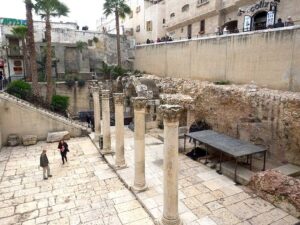
And then, my thought was suddenly interrupted when I noticed something strange. Perched atop these massive columns were small stones. How did these rocks end up on the pillars? How could they have landed up there? And, how long had they been there?
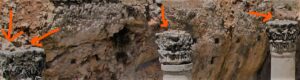
These questions continued to stump me for quite some time.
As I sensed upon arriving in the Old City, leaving would be no simple task. That three-week vacation from my job as a stringer for the San Francisco Chronicle in Belgrade, Yugoslavia, ended up as a nine-year chapter. For almost three of those years, the Old City was my backyard and playground. I became intimately acquainted with every one of those narrow streets and winding pathways. Waking with friends, rabbis and mentors, discussing life’s deeper meaning through the lens of ancient Jewish wisdom, became my full-time pursuit.
And the mystery of those anomalous rocks, resting upon the Roman Columns of the Cardo, remained unsolved.
Until one day, on a pleasant afternoon stroll through the Old City, the great secret was finally revealed.
The answer to this mystery and the journey that it led me on is the subject of this podcast.
It was lunchtime and I was strolling the narrow alleyways of the Rova (The Jewish Quarter of the Old City) when I arrived at those foreboding columns. Looking down from above, I noticed a group of Jewish children with their velvet yarmulkes (brimless caps, traditionally worn by Jewish men and boys) and payot (traditional side-locks) playing an innocent game during recess. Each boy, upon his turn, would step forward with a rock in hand and launch the stone into the air, hoping to land it squarely upon the capital of one of the Corinthian structures.
At first I thought to myself, “how cute, look at these boys having fun with their makeshift playground equipment.”
But then, a thought hit me that would forever change the way I would look at those rocks atop the pillars.
These columns once represented the glory and power of the Mighty Roman Empire- the most extensive political and social structure in western civilization at its time that ruled more than half the globe. But where is the Roman Empire today? Gone. Disappeared.
And for that matter, where are the Egyptian Empire, the Babylonian Empire, the Greek Empire and the Ottoman Empire? Gone. Disappeared. Does anyone have a Babylonian dentist? How about an Ottoman accountant? These empires simply ceased to exist.
As Mark Twain wrote in 1897:
“The Egyptians, the Babylonians and the Persians rose, filled the planet with sound and splendor, then faded to dream-stuff and passed away; the Greeks and Romans followed and made a vast noise, and they were gone; other people have sprung up and held their torch high for a time but it burned out, and they sit in twilight now, and have vanished.
The Jew saw them all, survived them all, and is now what he always was, exhibiting no decadence, no infirmaties, of age, no weakening of his parts, no slowing of his energies, no dulling of his alert but aggressive mind. All things are mortal but the Jews; all other forces pass, but he remains. What is the secret of his immortality?”
Watching those rambunctious boys that day, tossing their rocks into the air, hoping to land them on top of the columns became the symbol in my mind of the rebirth and the return of the Jewish nation to our homeland after 2,000 years of exile.
Those pillars which once represented the indestructible power of the Mighty Roman Empire had now become the playthings of little Jewish children who have returned to the streets of the ancient city of our ancestors. I would never look at those columns the same. And, in fact, I would never look at anything the same. I suddenly realized why my connection to this place was so deep and powerful. We have come home. For 2,000 years we dreamed and hoped… and now? Little boys are using the acheological remants of a bygone empire to entertain themselves during a break from their studies? What could possibly be more astounding?
And you know what? We never doubted that one day this would happen. Why? Because the Jewish prophet Zacharia, who walked these same alleys of Jerusalem over 2600 years ago, told it would. As we were being carted out in shackels into the darkness of two millennia long exile, the prophet consoled us:
This is what the Hashem, G-d of Hosts says: “Old men and old women will again sit along the streets of Jerusalem, each with a staff in hand because of great age. And the streets of the city will again be filled with boys and girls playing there.” (Zecharia 8:5)
And this is where our journey begins.






Can I simply say what a comfort to find someone who actually understands what they are discussing on the net. You definitely understand how to bring an issue to light and make it important. More people should check this out and understand this side of the story. I was surprised that you are not more popular since you most certainly have the gift.